
After Trump’s victory in the 2024 election, there’s an ongoing debate about whether the “country turned red”, or whether the “Democrats lost it”. These terms are imprecise, and could mean different things to different people. In the analysis that follows, I analyze the expected popular vote, and show several things:

- In terms of people who voted for the same party in 2024 and in 2020, Trump and Harris are expected to have brought out the same number (64.7M vs 64.8M, respectively)
- In terms of people who voted for different parties in 2024 vs 2020, Trump is expected to have switched more people than Harris (5.7M vs 3.9M, respectively)
- In terms of people who didn’t vote, Trump is expected to have brought out more new voters than Harris (7.9M vs 7.3M)
- In terms of people who voted in 2020 but chose to stay at home and not vote in 2024, it is expected that only 2.3M Trump 2020 voters did so, as opposed to 7.4M Biden 2020 voters
So in some sense, the country “did turn red” if by that we mean that more people who weren’t Republicans in 2020 became Republicans in 2024 than people who weren’t Democrats in 2020 and who became Democrats in 2024 (i.e. (5.7 + 7.9) – (3.9 + 7.3) = 2.5M in favor of Republicans). On the other hand, and perhaps in a bigger sense, the “Democrats lost it”, as far more 2020 Democrat voters chose to stay home and not vote for Harris than 2020 Republican voters who chose to stay home and not vote for Trump (2.3M vs 7.4M). That margin is significant, in the sense that Harris is expected to lose the popular vote by 2.3M people, and could have easily won it had more 2020 Biden voters showed up. Detailed analysis below.
Nate Cohn (New York Times) estimates that the final popular vote tally will be about 157.5M. Also, based on exit polls, we have a good breakdown of the composition of Trump and Harris’ voters, broken down into 4 categories (see graph below; to understand how to interpret this graph, we can take a look at the first row as an example: 44% of 2024 voters voted for Joe Biden in 2020; of those, 93% voted for Kamala Harris, 6% for Trump, and 1% for 3rd parties). With the overall popular vote (estimate), and this breakdown (in the graph), we can calculate the source of Trump and Harris votes vs 2020.
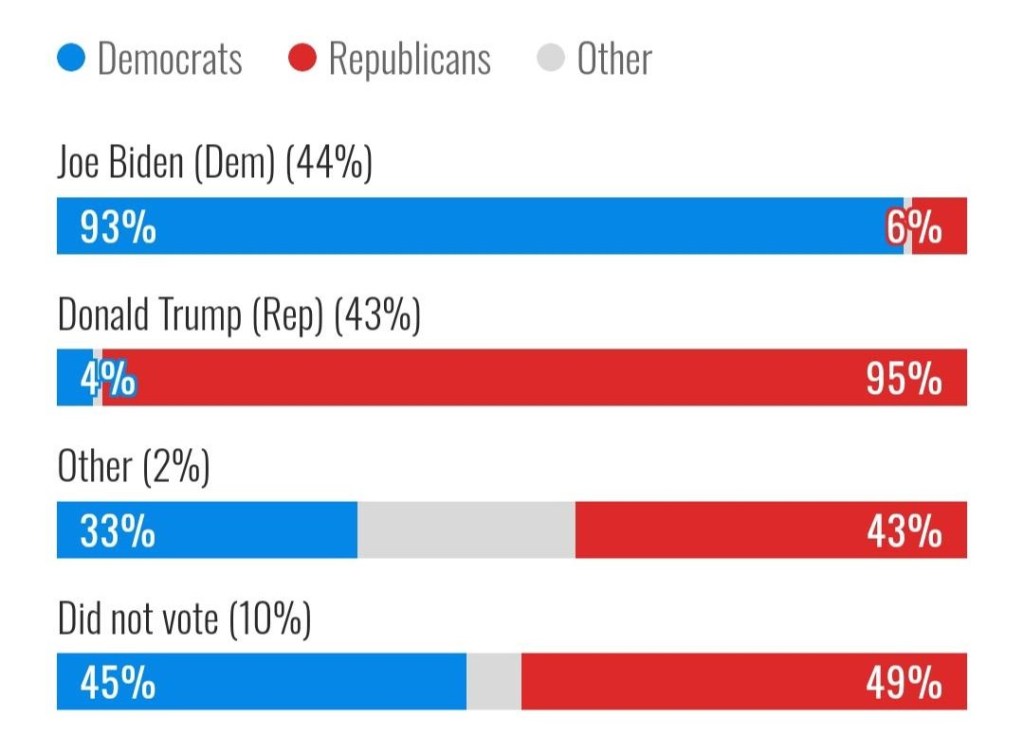
Note: there is a “missing 1%” in those 2024 voter breakdowns in the graph due to rounding (i.e. 0.44 + 0.43 + 0.02 + 0.49 = 0.99). We want to be as accurate as possible, but not knowing the breakdown of that 1%, we choose to allocate that 1% evenly across the 4 buckets (i.e. each bucket gets an extra 0.25%). With that (very minor) caveat in mind, let’s start with Trump:
- Trump voters in 2024 who were Biden voters in 2020: 157.5 * 0.4425 * 0.06 = 4.18M
- Trump voters in 2024 who were Trump voters in 2020: 157.5 * 0.4325 * 0.95 = 64.71M
- Trump voters in 2024 who were 3rd party voters in 2020: 157.5 * 0.0225 * 0.43 = 1.52M
- Trump voters in 2024 who didn’t vote in 2020: 157.5 * 0.1025 * 0.49 = 7.91M
Total vote for Trump: 4.18 + 64.71 + 1.52 + 7.91 = 78.32M
Let’s now do Harris:
- Harris voters in 2024 who were Biden voters in 2020: 157.5 * 0.4425 * 0.93 = 64.82M
- Harris voters in 2024 who were Trump voters in 2020: 157.5 * 0.4325 * 0.04 = 2.72M
- Harris voters in 2024 who were 3rd party voters in 2020: 157.5 * 0.0225 * 0.33 = 1.17M
- Harris voters in 2024 who didn’t vote in 2020: 157.5 * 0.1025 * 0.45 = 7.26M
Total vote for Harris: 64.82 + 2.72 + 1.17 + 7.26 = 75.97
Now let’s do 3rd parties:
- 3rd party voters in 2024 who were Biden voters in 2020: 157.5 * 0.4425 * 0.01 = 0.7M
- 3rd party voters in 2024 who were Trump voters in 2020: 157.5 * 0.4325 * 0.01 = 0.68M
- 3rd party voters in 2024 who were 3rd party voters in 2020: 157.5 * 0.0225 * 0.24 = 0.85M
- 3rd party voters in 2024 who didn’t vote in 2020: 157.5 * 0.1025 * 0.06 = 0.97M
Total vote for Harris: 0.7 + 0.68 + 0.85 + 0.97 = 3.2
So the delta in popular vote in favor of Trump should be 78.32 – 75.97 = 2.35M in favor of Trump. This also translates to Trump winning 78.32/157.5 = 49.7% of the popular vote, Harris winning 75.97/157.5 = 48.2% of the popular vote (so Trump wins the popular vote by 1.5%), and 3rd parties winning ~2% of the popular vote.
Let’s do some checks: (1) Nate Cohn at the NYT estimates that Trump will win popular vote by 1.6% vs our 1.5%, so we’re off by 0.1% (2) Based on current tallies, 3rd parties have 2.2M votes (time stamp: 11/8/2024 at 4AM EST), with an expected additional ~0.35M votes based on current trends for a total of ~2.55M, so we’re about 0.65M off. So we’re only slightly off based on these two checks, and likely underestimating Trump and Harris by about ~0.3M votes each (likely because the split of that missing 1% isn’t uniform across all 4 buckets, and because exit polls and Cohn’s estimates don’t perfectly line up; we could tweak this to reduce this small error, but it’s not worth it as it won’t change any of the upcoming conclusions in any significant way).
With the above caveat in mind, let’s now look at 2020 voter totals: (1) Biden got 81.28M votes, (2) Trump got 74.22M votes, and (3) 3rd parties got 2.92M votes, for a total of 158.4M votes (a record).
Now let’s look at Trump’s 2024 numbers vs 2020. Trump voters in 2024 who were Trump voters in 2020 are estimated to be 64.71M. So what happened to the remaining 74.22 – 64.71 = 9.51M Trump voters? They fall into 3 buckets: (1) those who switched parties (2) those who died (3) those who stayed home and didn’t vote. Let’s estimate each bucket:
- Those who switched parties: Harris voters in 2024 who were Trump voters in 2020 + 3rd party voters in 2024 who were Trump voters in 2020 = 2.72 + 0.68 = 3.4M
- Those who died between the 2024 and 2020 election: we’ll use 2022 as our calculation year (reasonable midpoint between 2020 and 2024). Based on the CDC, 3.28M residents died in 2022. We then have to restrict this to adults a) (~99% of deaths were over 18), b) citizens (13.9% of the US population was foreign-born, with 53.1% of those having become naturalized citizens; so 1 – 0.139 * (1 – 0.531) = 93.5%) c) voting citizens (turnout was 66.6% in 2020) d) Trump voters (46.8% based on 2020 election). Doing the math, this gives: 3.28 * 99% * 93.5% * 66.6% * 46.8% = ~0.95M. Over 4 years, that gives 0.95 * 4 = 3.8M
- Those who stayed at home (and didn’t vote): 9.51 – 3.4 – 3.8 = 2.31M
Now let’s look at Dems’ 2024 numbers vs 2020. Harris voters in 2024 who were Biden voters in 2020 are estimated to be 64.82M. So what happened to the remaining 81.28 – 64.82 = 16.46M Biden voters from 2020? They also fall into 3 buckets: (1) those who switched parties (2) those who died (3) those who stayed home and didn’t vote. Let’s estimate each bucket:
- Those who switched parties: Trump voters in 2024 who were Biden voters in 2020 + 3rd party voters in 2024 who were Biden voters in 2020 = 4.18 + 0.7 = 4.88M
- Those who died: we’ll use 2022 as our calculation year (reasonable midpoint between 2020 and 2024). Based on the CDC, 3.28M residents died in 2022. We then have to restrict this to adults a) (~99% of deaths were over 18), b) citizens (13.9% of the US population was foreign-born, with 53.1% of those having become naturalized citizens; so 1 – 0.139 * (1 – 0.531) = 93.5%) c) voting citizens (turnout was 66.6% in 2020) d) Biden voters (51.3% based on 2020 election). Doing the math, this gives: 3.28 * 99% * 93.5% * 66.6% * 51.3% = ~1.04M. Over 4 years, that gives 1.04 * 4 = 4.16M
- Those who stayed at home: 16.46 – 4.88 – 4.16 = 7.42M
Let’s take stock. The main reason Harris lost the popular vote is because far more 2020 Biden voters chose to stay home than 2020 Trump voters (7.4M vs 2.3M, for a delta of 5.1M).
A secondary reason was because Trump was able to flip more votes from 2020 Dems and 3rd parties than Harris was with 2020 Republicans and 3rd parties (5.7M vs 3.9M, for a delta of 1.8M).
A third reason was because Trump managed to turn out more new voters (who hadn’t voted in 2020) than Harris (7.9M vs 7.3M, for a delta of 0.6M).
All these reasons clearly point to Democratic voters being less enthused in 2024 with Harris than they were with Biden in 2020. Why that was the case is a separate question.
 Notes From Underground