• Blog
  • Welcome

Notes From Underground

~ by Nicolas Sawaya

Notes From Underground

Category Archives: American Politics

Clinton vs. Sanders Primaries: Update 3-18

18 Friday Mar 2016

Posted by Nicolas Sawaya in American Politics

≈ Leave a comment

Tags

Clinton, Democratic Primaries, Sanders

clinton-vs-sanders

Clinton vs. Sanders (Nigel Paray for CNN)

Projections were developed right after Super Tuesday on March 1st and will not be changed. See here.

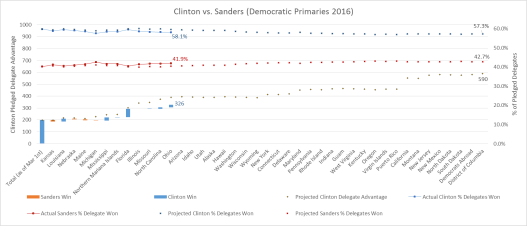
Right after Super Tuesday, Clinton led Sanders by 199 pledged delegates and had won 59.7% of the pledged delegates (vs. 40.3% for Sanders). Since then, Clinton has widened her lead to 326 pledged delegates and leads Sanders 58.1% vs. 41.9% in total pledged delegate %. The model projected a lead of 389 pledged delegates for Clinton at this point, for a 59.6% vs. 40.4% Clinton lead, so the model is slightly over-projecting in favor of Clinton (by +1.5%). Final model projections are +590 pledged delegates and a 57.3% vs. 42.7% win for Clinton. See table and graph below:

Clinton vs Sanders Graph 3-18-16

Fig 1. The graph shows (off the left-hand axis) the delegates won or lost by Clinton after each primary (blue bars mean Clinton won the state; red means Sanders won); the size of the bars reflect the difference in delegates won or lost for each state. The bars are staggered in “water-fall” fashion to reflect Clinton’s actual total delegate lead, which is compared against model projections of Clinton’s delegate lead (black dots). The graph also tracks (off the right-hand axis) actual delegate % won for Clinton (blue line) vs. Sanders (red line), and compares against model projected % for Clinton (blue dots) vs. Sanders (red dots)

Clinton vs Sanders Table 3-18-16

Table 1. The table tracks actual pledged delegates won by Clinton and Sanders vs. model projected delegates, and calculates the delta between the two

How the model “works”:

The model regressed delegates won by Clinton vs. Sanders for primaries on March 1st and before against the “racial makeup” of those states. The resulting regression coefficients are then used to project future primaries based on the “racial makeup” of those future states.

Clinton vs. Sanders Primaries: Update 3-14

14 Monday Mar 2016

Posted by Nicolas Sawaya in American Politics

≈ Leave a comment

Tags

Clinton, Democratic Primaries, Sanders

clinton-vs-sanders

Clinton vs. Sanders (Nigel Paray for CNN)

For fun, I plan on updating the Clinton vs. Sanders nomination battle after each major set of primaries and tracking actual pledged delegate counts vs. projected delegate counts based on the model I developed right after Super Tuesday (March 1st). See previous post here.

Projections were developed right after March 1st and will not be changed but I will update the actual count to compare against model projections.

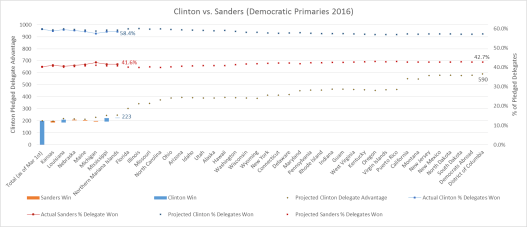
Right after Super Tuesday, Clinton led Sanders by 199 delegates and had won 59.7% of the pledged delegates (vs. 40.3% for Sanders). Since then, Clinton has widened her lead to 223 pledged delegates and leads Sanders 58.4% vs. 41.6% in total pledged delegate %. The model projected a lead of 249 delegates for Clinton at this point, for a 59.4% vs. 40.6% Clinton lead, so the model is slightly over-projecting in favor of Clinton. Final model projections are +590 delegates and a 57.3% vs. 42.7% win for Clinton. See table and graph below:

Clinton vs Sanders Graph 3-14-16

Fig 1. The graph shows (off the left-hand axis) the delegates won or lost by Clinton after each primary (blue bars mean Clinton won the state; red means Sanders won); the size of the bars reflect the difference in delegates won or lost for each state. The bars are staggered in “water-fall” fashion to reflect Clinton’s actual total delegate lead, which is compared against model projections of Clinton’s delegate lead (black dots). The graph also tracks (off the right-hand axis) actual delegate % won for Clinton (blue line) vs. Sanders (red line), and compares against model projected % for Clinton (blue dots) vs. Sanders (red dots)

Clinton vs Sanders Table 3-14-16

Table 1. The table tracks actual pledged delegates won by Clinton and Sanders vs. model projected delegates, and calculates the delta between the two

How the model “works”:

The model regressed delegates won by Clinton vs. Sanders for primaries on March 1st and before against the “racial makeup” of those states. The resulting regression coefficients were then used to project future primaries based on the “racial makeup” of those future states.

Why Bernie Sanders won’t win: Demographics

04 Friday Mar 2016

Posted by Nicolas Sawaya in American Politics

≈ Leave a comment

Tags

Clinton, Democratic Primaries, Sanders

clinton-vs-sanders

Clinton vs. Sanders (Nigel Paray for CNN)

Much has been made about Bernie Sanders’ poor performance with minorities so far in the democratic primaries (see here and here). Indeed, an analysis by ABC news of exit polls of all democratic primaries so far reveals that only 15% of black voters and 36% of Hispanics have voted for Sanders (vs. 83% and 63%, respectively, for Clinton); by contrast, Sanders has picked up 48% of the white vote (vs. 50% for Clinton).
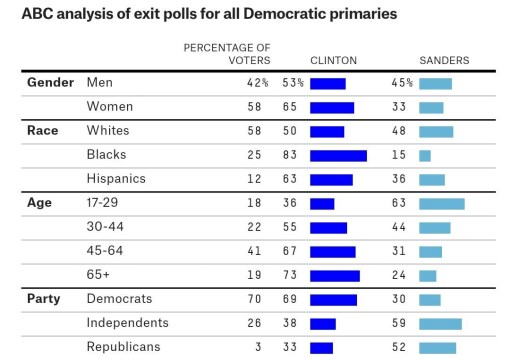
ABC Analysis of Democratic Exit Polls

Sanders supporters acknowledge this fact, but counter this by pointing to a more favorable landscape going forward in remaining states, especially post March 22nd. Although this point is true (as we’ll see below), the question remains: is it favorable enough for Sanders to win the nomination. As such, we’re interested in answering the following questions:

  • Does the “racial makeup” of a state (i.e. White / Black / Hispanic demographic split) have any value in predicting the pledged delegate vote?
  • If it does, what do Sanders and Clinton’s delegate projections look like for the remaining races?
  • What would it take for Sanders to win the pledged delegates race?

In order to answer the first question, we regress pledged delegates won by Clinton vs. Sanders for primaries on March 1st and before against the “racial makeup” of those states and check the quality of the fit. The purpose of the regression is to find a set of optimal coefficients that, when multiplied by the “racial demographics” of each state and then by the number of delegates available for that state, result in a set of calculated pledged delegates that match as closely as possible the actual delegates won by each candidate for states that have already voted. The results of the regression are listed in Table 1:

Table 1 Clinton vs Sanders

Table 1. Actual pledged delegates won by Clinton vs. Sanders compared against calculated pledged delegates from regression model

The quality of the fit can intuitively be appreciated by comparing the results of the regression (columns labeled “Projected Delegates”) vs. number of delegates actually won (columns labeled “Delegates Won”) on a state by state level. The closer the regression results are to the actuals (i.e. the closer the “Projected Delegates Delta” columns are to 0), the better the fit. Even though the regression is not perfect (in the sense that the delta between our regression results and the actuals is not 0 for each state), the deviations are relatively minor. Mathematically, this intuition can be assessed more formally by checking the R2 coefficient of the regression (there are other ways as well). The closer this coefficient is to 1, the better the regression is. Given that our R2 coefficient is 0.99 for Clinton and 0.965 for Sanders (the adjusted R2 for Clinton is 0.986 and 0.952 for Sanders), we can conclude that this a good regression (see here and here for a good introduction to regression). This implies that there is a strong correlation between candidate preference and the “racial make-up” of a state, at least based on the states that voted on March 1st and before. Although this strong correlation doesn’t necessarily imply anything causal on its own (in the sense that this could be a spurious correlation), there seems to be a lot of independent evidence that this is indeed a meaningful correlation.

And what of the regression coefficients that yielded the above results? It will come as no surprise that the coefficients reflect what we expected, which is to say that minorities play a very important part of Clinton’s success, while the White vote explains most of Sanders’ success.  For completeness, we list the coefficients here:

Regression coefficients Clinton vs Sanders

In order to answer the second question, we multiply the regression coefficients by the “racial makeup” of future states and then by the pledged delegates available for those future states to project future primaries. Our total projected delegates for these future states is presented in table 2:

Table 2 Clinton vs Sanders

Table 2. Projected pledged delegates from regression model

If we look at the projections based on our regression method, we see that Sanders performs better than Clinton in states with a large fraction of White voters, while Clinton does better in more diverse states. Overall, we expect that Clinton will win 2321 delegates (57.3% of total pledged delegates) vs. Sanders’ 1730 delegates (42.7%). As such, we can see that Sanders loses the pledged delegates vote handily.

The third and final question can now be asked: what would it take for Sanders to win? We choose to answer this question by asking a proxy question: what would the candidate preference by White / Black / Hispanic voters have to be going forward for Sanders to win the nomination?

There are multiple ways to do this, and we run three different scenarios. For all scenarios, we assume that the future popular vote won is proportional to the number of pledged delegates won; this is a reasonable assumption, on average, as the Democratic primaries proportionally allocate their delegates once a 15% threshold of the vote is met:

  • Assuming minorities continue voting as they have in states that have already voted, Sanders would have to win about 70% of the White vote going forward. Given that Sanders has only managed to win 48% of the White vote so far, expecting him to win an additional 20%+ going forward seems implausible.
  • Assuming Sanders continues to capture the same amount of the White vote as he has, he would need to capture 70% of the Black and Hispanic vote to win the nomination. This seems even more implausible given his current percentages with minorities.
  • Assuming Sanders captures 60% of the White vote (a +12% increase vs. today), he would need to capture 50% of the Black and Hispanic vote (a +36% and +14% increase vs. today, respectively) to win the nomination. As such, even with such a drastic increase in the White vote captured, Sanders would somehow have to triple his percentage with Black voters, and significantly increase his support with Hispanics. Again, this simply does not seem realistic.

Note that throughout this analysis, we have ignored super-delegates (who favor Clinton). One of the interesting conclusions resulting from this exercise is that talk of super-delegates in this race is superfluous: unless Clinton gets forced out of the race (because she gets indicted, imprisoned, or some other far-fetched scenario) Sanders is extremely unlikely to win the popular vote, because of demographics.

Some notes:

“Racial makeup” in red in Tables 1 and 2 come from 2016 democratic primary exit polls; in black from 2008 democratic primary exit polls (note that this helps Sanders as minorities, which Clinton wins handily, have increased their percentages over the past 8 years); in blue for Florida from the latest 2016 democratic primary poll available; in green from the “racial make-up” of the state as a whole (no better data was available) based on, for the most part, the 2010 census; in gray for Democrats Abroad based on an assumption that neither candidate is favored given lack of information.

Encouraging ethnic cleansing in Congress

20 Saturday Feb 2016

Posted by Nicolas Sawaya in American Politics, Palestine, Zionism

≈ Leave a comment

Tags

Ethnic Cleansing, Palestine, US Congress

ethnic-cleansing-palestine

Palestinian refugees flee Galilee in the fall of 1948 (Fred Csasznik)

How many of us know that as recently as Nov 2014, a US Congressman in the House introduced legislation that calls on Israel to formally annex all the Palestinian Occupied Territories (West Bank / Gaza / East Jerusalem) and encourages the ethnic cleansing of Palestinians from these territories?

The bill was introduced by Steve Stockman (Texas, 36th district) and was referred to the Committee on Foreign Affairs, where it (thankfully) died. Stockman isn’t in Congress anymore, but the fact that this shit even gets introduced by these people is mind-bending. The best part of this bill is that it was pitched as a service for Palestinians to “increase their standards of living” and is dubbed “The Right of Return Act”. To where you might ask? Jordan. You really can’t make this stuff up.

H.R. 5734 (113th): Right of Return Act

Excerpt: […]

“The Congress of the United States shall take the following course of action:

(1) The Secretary of State shall call for the State of Israel to increase the standard of living of those living in Judea, Samaria, and Gaza by extending its sovereignty over those territories, and for the Palestinian Arab residents currently residing in those areas to be granted citizenship in the countries that controlled those territories from 1949 to 1967 and have a right of return to those countries.

(2) As long as part of the unity government of the Palestinian Authority refuses to allow the right of return to the countries that controlled Judea, Samaria, and Gaza from 1949 to 1967, no funds appropriated by Congress under any Act may be obligated or expended to provide any United States assistance, loan guarantee, or debt relief to the Palestinian Authority.

(3) The Secretary of State of the United States shall take such action as will ensure that refugees are allowed to be properly allowed to return into their host countries in accordance with the regulations set forth by the United Nations High Commission for Refugees (UNHCR).

(4) All United States assistance, loan guarantee, and debt relief that currently goes to the United Nations Relief and Works Agency for Palestinian Refugees in the Near East (UNRWA) shall instead be used to assist those who exercise their right of return to the countries who controlled Judea, Samaria, and Gaza from 1949 to 1967”


American vs. Lebanese Democracy

04 Thursday Dec 2014

Posted by Nicolas Sawaya in American Politics, Lebanon

≈ Leave a comment

Tags

Democracy, Lebanon

lebanon-tomatoes

Activists threw tomatoes at banner bearing pictures of members of parliament and marked ‘You have failed’ [EPA; Al Jazeera]

Today, American citizens go to vote in their mid-term elections that will likely result in a different Congress. In a couple of days, Lebanese parliamentarians go to vote for themselves to extend their already illegal mandate.

In my more cynical moments, I ask myself whether the former is better than the latter. Is it better to engage in an illusion of democracy, where research has shown that the average American voter has essentially no impact of policy in this country, or is it better to simply not delude oneself in thinking that voting makes a difference within the context of a dysfunctional system (whether of the American or Lebanese variety) by simply not having that ability to vote (and until the system is fixed).

Is it better to derive satisfaction from casting a vote for an elephant or a donkey that both turn into lap dogs beholden to special interest groups once in power and whose positions are almost identical on most topics (minus details), or is it better to rip that veneer of respectability and that veil of deceit by publically giving the middle finger to your people and saying fuck it: you all knew this was a charade anyway, and now we’re making it official; no vote for you.

Unless the outcome of voting is a reflection of the will of the people (on policy issues), what’s the point in engaging in this meaningless exercise every 2 or 4 years? Perhaps the system needs to descend into levels of Lebanese dysfunctionality in order to have an honest conversation about fixing a Democracy with no clothes.

Newer posts →

Recent Posts

  • Issa El-Issa – Celebrating a Giant of Palestinian Journalism on the 75th Anniversary of his Death
  • The Views of Israeli Society on the Gaza Genocide
  • Did the “country turn red” or did the “Democrats lose it”?
  • Tim Walz’s Record on Palestine
  • Josh Shapiro and Israel

Recent Comments

theblackotterblog's avatartheblackotterblog on Zionism’s collaboration…
Nicolas Sawaya's avatarnicolassawaya on Zionism’s collaboration…
Hadeel's avatarHadeel on Zionism’s collaboration…

Archives

  • July 2025
  • November 2024
  • August 2024
  • September 2020
  • August 2020
  • May 2020
  • March 2020
  • November 2019
  • October 2019
  • June 2019
  • May 2019
  • April 2019
  • October 2018
  • May 2017
  • February 2017
  • January 2017
  • December 2016
  • July 2016
  • May 2016
  • April 2016
  • March 2016
  • February 2016
  • October 2015
  • January 2015
  • December 2014
  • September 2014
  • August 2014
  • July 2014
  • July 2013

Categories

  • American Current Events
  • American Politics
  • Arts
  • Energy
  • Islam
  • Law
  • Lebanon
  • Math
  • Palestine
  • Philosophy
  • Poetry
  • Sports
  • Syria
  • Terrorism
  • Zionism

Recent Posts

  • Issa El-Issa – Celebrating a Giant of Palestinian Journalism on the 75th Anniversary of his Death
  • The Views of Israeli Society on the Gaza Genocide
  • Did the “country turn red” or did the “Democrats lose it”?
  • Tim Walz’s Record on Palestine
  • Josh Shapiro and Israel

Recent Comments

theblackotterblog's avatartheblackotterblog on Zionism’s collaboration…
Nicolas Sawaya's avatarnicolassawaya on Zionism’s collaboration…
Hadeel's avatarHadeel on Zionism’s collaboration…

Archives

  • July 2025
  • November 2024
  • August 2024
  • September 2020
  • August 2020
  • May 2020
  • March 2020
  • November 2019
  • October 2019
  • June 2019
  • May 2019
  • April 2019
  • October 2018
  • May 2017
  • February 2017
  • January 2017
  • December 2016
  • July 2016
  • May 2016
  • April 2016
  • March 2016
  • February 2016
  • October 2015
  • January 2015
  • December 2014
  • September 2014
  • August 2014
  • July 2014
  • July 2013

Categories

  • American Current Events
  • American Politics
  • Arts
  • Energy
  • Islam
  • Law
  • Lebanon
  • Math
  • Palestine
  • Philosophy
  • Poetry
  • Sports
  • Syria
  • Terrorism
  • Zionism

Blog at WordPress.com.

  • Subscribe Subscribed
    • Notes From Underground
    • Already have a WordPress.com account? Log in now.
    • Notes From Underground
    • Subscribe Subscribed
    • Sign up
    • Log in
    • Report this content
    • View site in Reader
    • Manage subscriptions
    • Collapse this bar
 

Loading Comments...